EPDM Rubber Hoses for Dishwashers: Internal Connections and Selection Guide
- Share
- publisher
- RESRUB
- Issue Time
- Oct 21,2026
Summary
Selecting EPDM rubber hoses for dishwasher internal connections involves more than matching the diameter. This article covers material compatibility, hot water and detergent exposure, hose routing, and connection fit. Suitability should be verified against product specifications and actual operating conditions.
MANUFACTURING PROCESSES / APPLIANCE CONNECTIONS
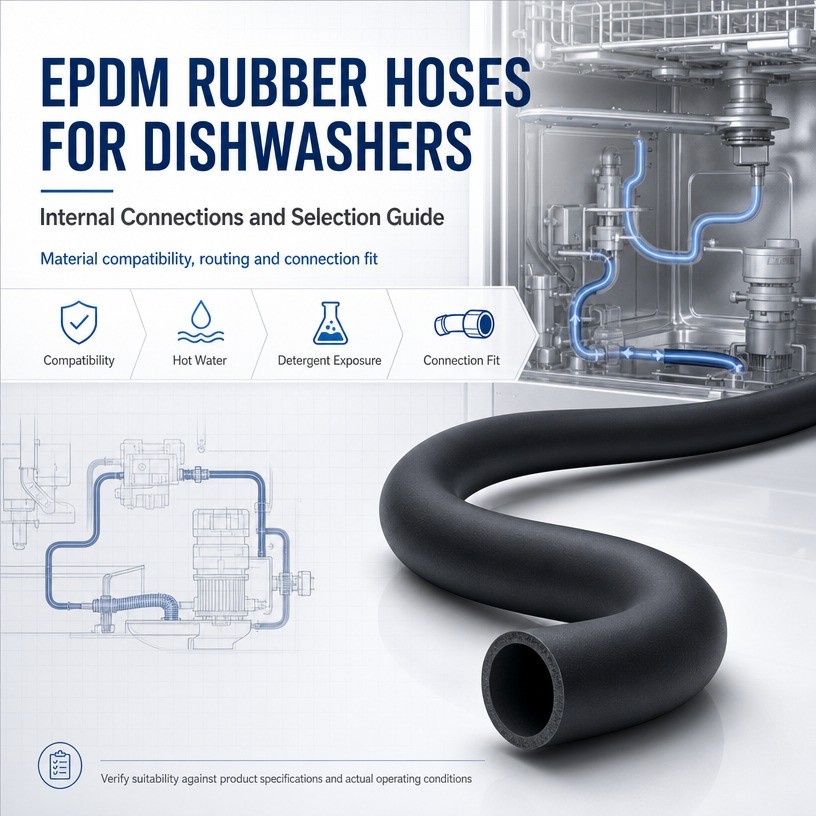
Selection starts with the application, not diameter alone. For OEM buyers and engineers evaluating EPDM rubber hoses for dishwasher internal connections, a useful review connects material choice, actual exposure, routing and joint design with manufacturing and inspection requirements.
Scope: internal appliance connections subject to product-specific validation. Images are application illustrations, not installation drawings, tested assemblies or proof of product performance.
SELECTION CHECK 01
Material compatibility: specify the compound, not just EPDM
For a dishwasher internal connection, the material name is only a starting point. An EPDM hose should be reviewed as a specific compound and finished part, together with the liquid it carries, the components it joins and the conditions it will experience.
- Identify the exact water path and whether the hose sees wash water, rinse water or intermittent contact.
- Request the proposed compound reference, hardness and relevant material data.
- Check any applicable appliance, chemical or water-contact requirements separately; the word EPDM does not establish approval.
Use our materials and process capabilities as a starting point for discussing the specification, not as a substitute for application-specific validation.
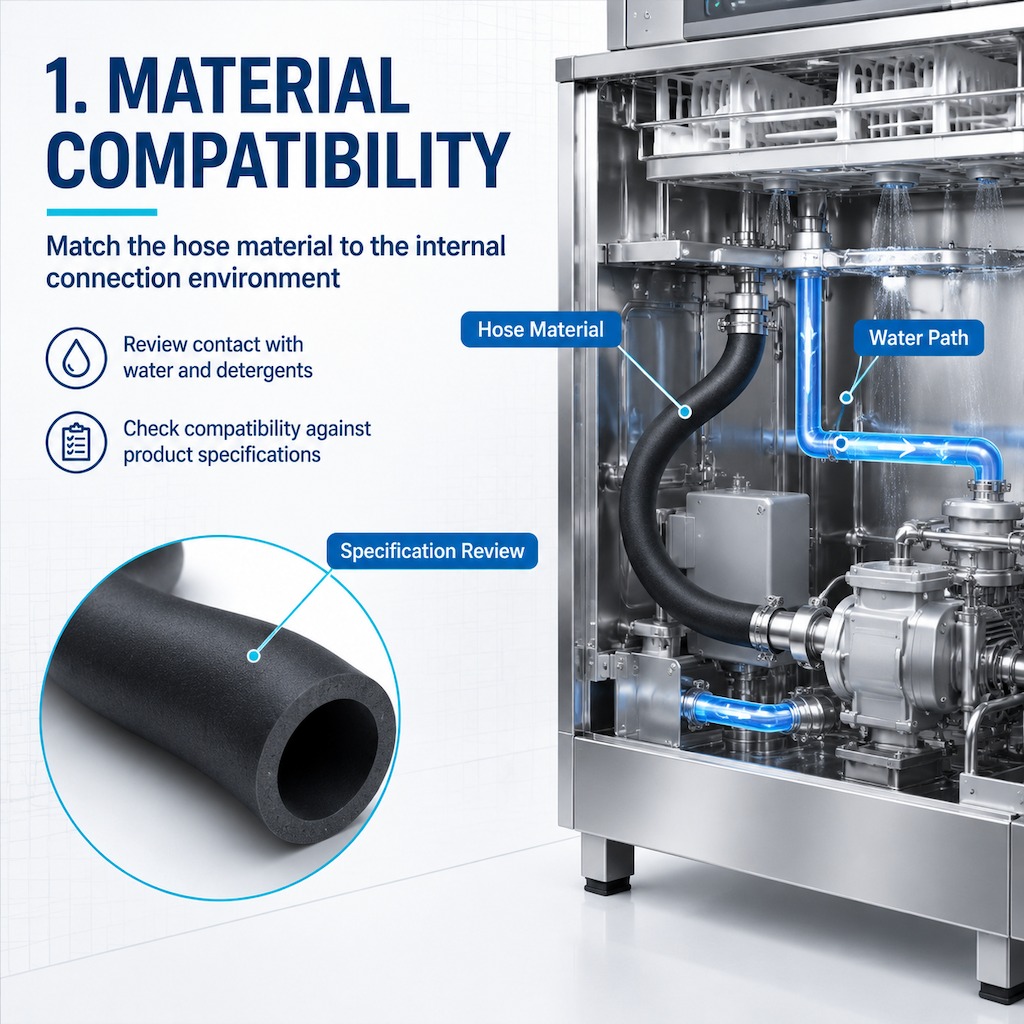
Application illustration: review the compound against the actual internal water path.
SELECTION CHECK 02
Hot water exposure: assess the complete operating cycle
A single maximum-temperature figure does not describe the complete duty of an internal dishwasher hose. Specify the normal water temperature, peak exposure, time at temperature and heating-and-cooling sequence. Also consider nearby heat sources and the external environment around the hose.
- Separate continuous exposure from short temperature peaks.
- Provide the expected cycle frequency and service-life target.
- Define inspection criteria after representative thermal cycling, including changes in dimensions, flexibility and connection sealing.
Request evidence for the selected hose construction and compound. Do not transfer a temperature rating from another EPDM product, a different fluid or an unassembled material sample.
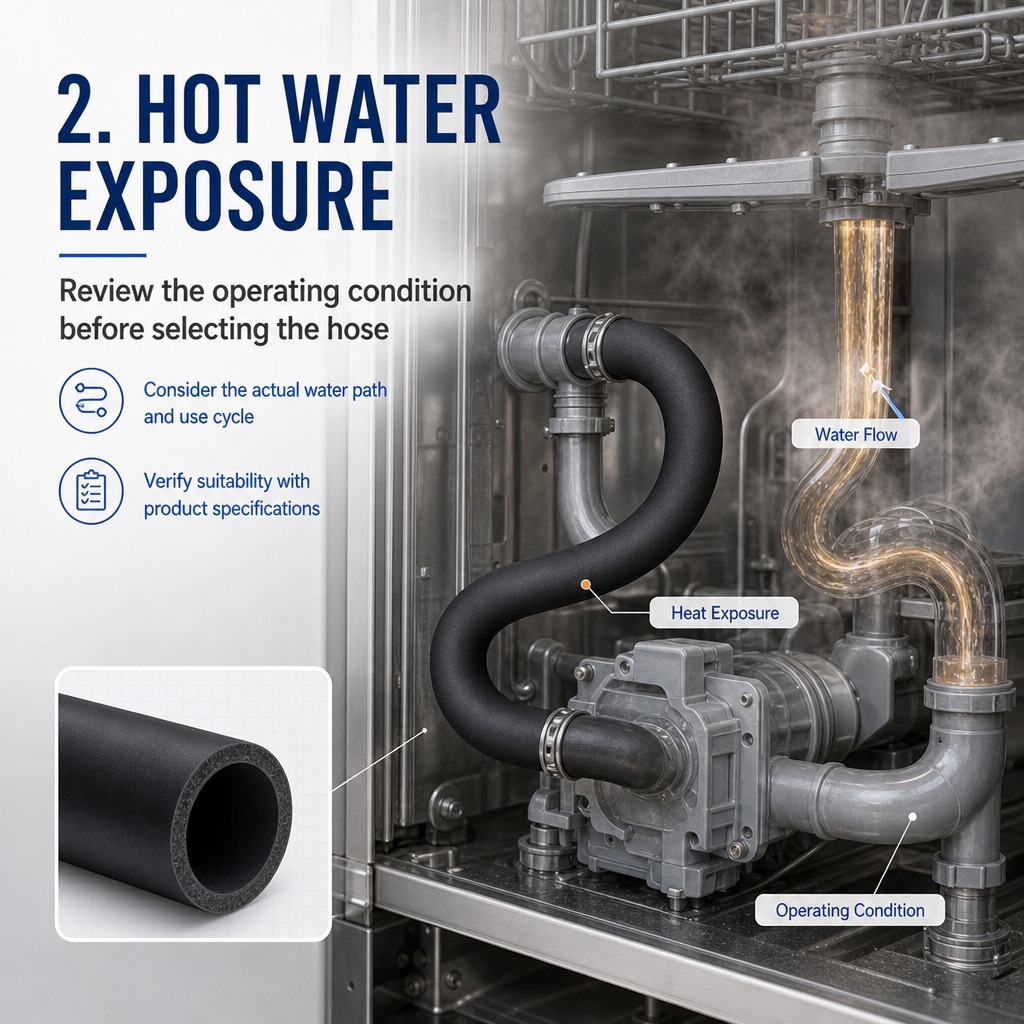
Application illustration: evaluate hot water exposure over the intended use cycle.
SELECTION CHECK 03
Detergent exposure: check the actual cleaning chemistry
Compatibility should be checked against the chemicals that will actually contact the hose. A household wash solution, rinse aid and maintenance cleaner may create different exposure conditions. Approval for water alone does not establish suitability for every detergent formulation.
- List detergent and rinse-aid identities, working concentrations and contact times.
- Include descaling or cleaning products if they are part of the intended maintenance procedure.
- Agree sample-exposure conditions and acceptance limits for swelling, hardening, cracking or other relevant changes.
Assess the proposed material under the combined chemical and thermal conditions of use. Keep the chemical list current if the appliance program or cleaning instructions change.
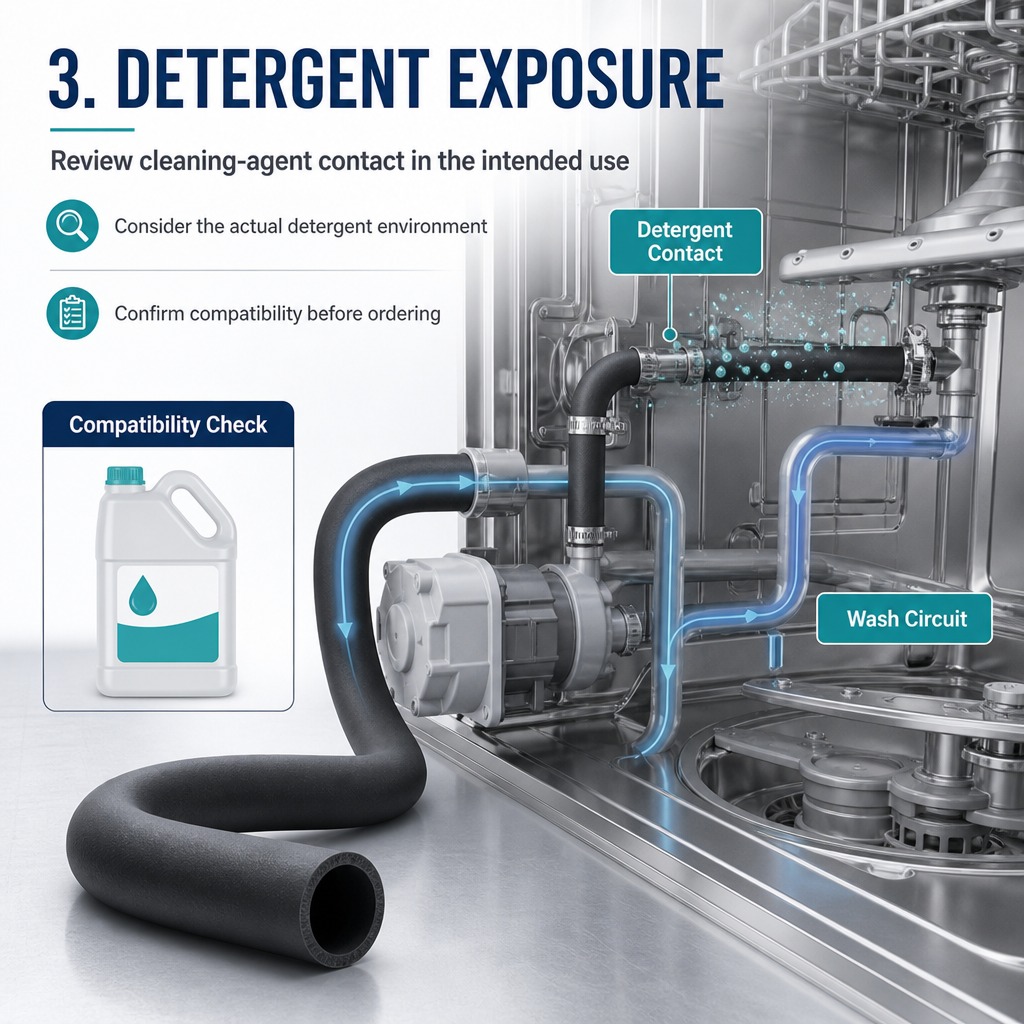
Application illustration: detergent compatibility needs its own review.
SELECTION CHECK 04
Hose routing: make space for bends, supports and movement
A hose that fits between two connection points is not necessarily suitable for the space between them. Review the installed route in the complete appliance, including access for assembly, movement during operation and the position of surrounding components.
- Avoid sharp bends, twisting, flattening and contact with sharp edges.
- Check clearance from hot surfaces, moving parts and electrical components.
- Position supports so they control movement without pinching the hose or loading the connection.
Use the selected product specification to define the minimum bend radius and any installation constraints. Do not assume that a straight extruded hose can replace a formed connection simply by forcing it into shape.
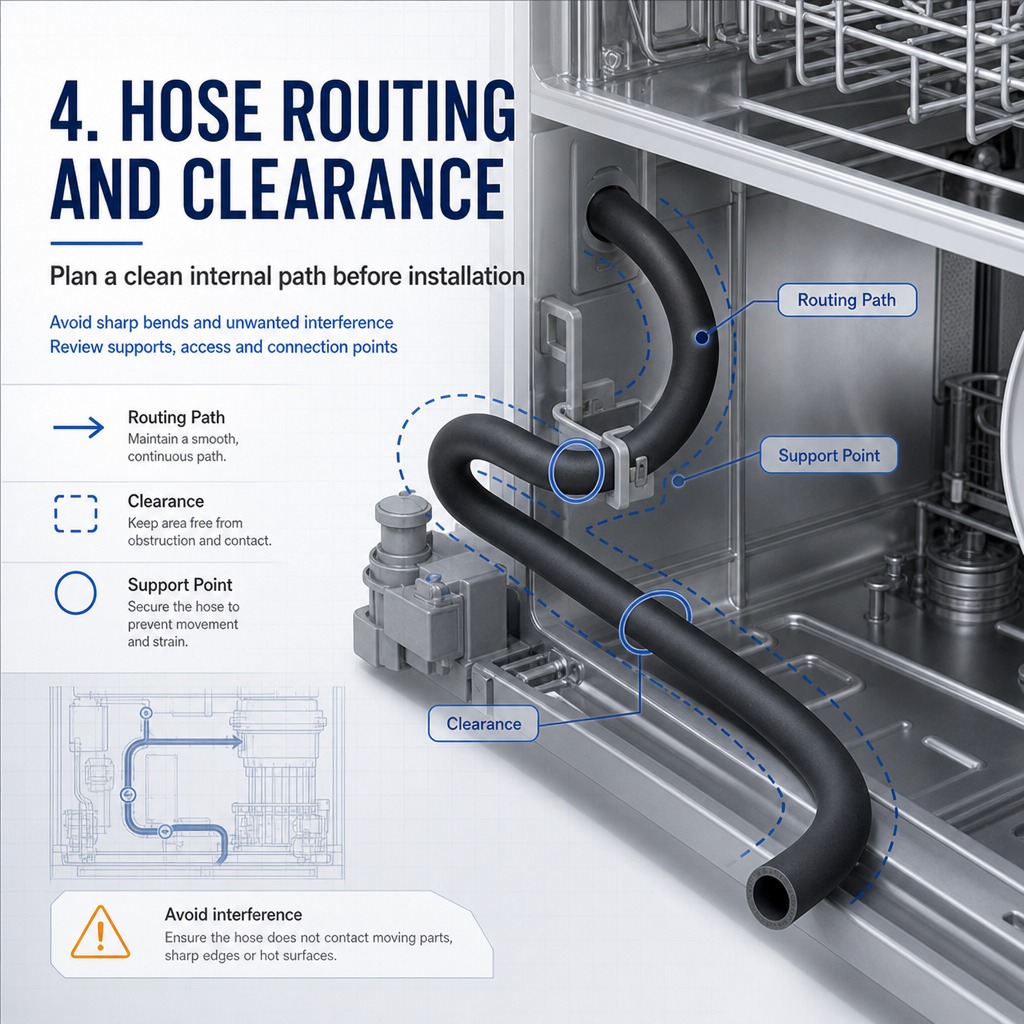
Application illustration: plan routing, support points and clearances together.
SELECTION CHECK 05
Connection fit: match dimensions and the retention method
Inside diameter is only one part of connection fit. Outside diameter, wall thickness, end geometry, hardness and dimensional tolerances all need to match the intended interface and retention method. A close visual match is not an approval criterion.
- Specify hose ID, OD, wall thickness, cut length and the tolerances that matter at the joint.
- Provide the mating connector drawing, insertion depth and approved clamp or retention arrangement.
- Validate assembly, sealing and retention using representative hoses and mating components.
Review our rubber hose and tubing range when defining a candidate. Final selection should follow the complete interface drawing, not a catalog image alone. Use the appliance-approved assembly procedure and fastening settings.
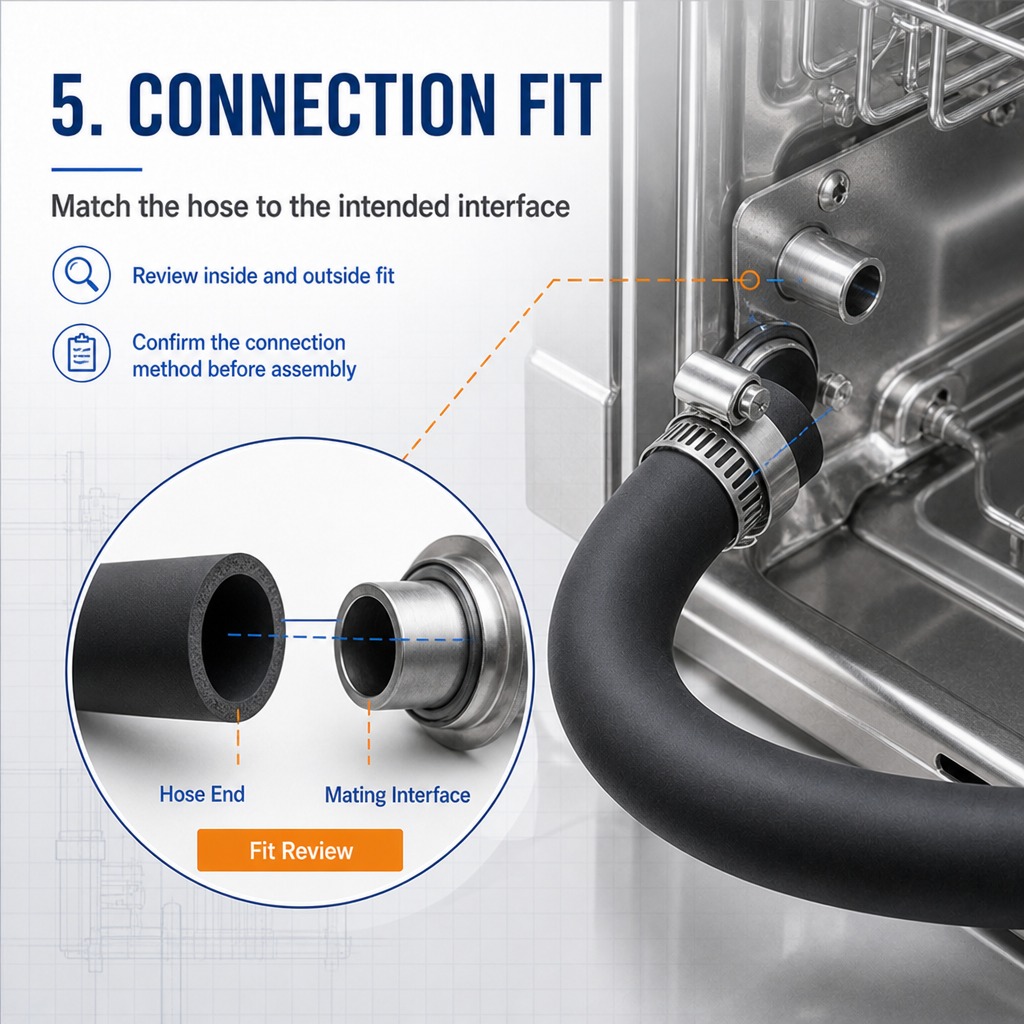
Application illustration: hose ends, mating interfaces and clamps must be reviewed as an assembly.
SELECTION CHECK 06
Final suitability review: move from a sample to an approved specification
Before ordering, assemble one controlled specification covering the hose, mating parts and application. The approval should state what has been tested, under which conditions and which results are acceptable. A sample that fits on the bench is not yet evidence of suitability throughout the appliance duty cycle.
- Confirm compound, dimensions, routing and connection details against the approved drawing.
- Agree functional checks using the intended thermal and chemical exposure, and the actual pressure or vacuum conditions where relevant.
- Record inspection results, sample approval, traceability and change-control requirements.
Pressure, temperature and service-life limits must come from the qualified product specification. This guide does not assign a pressure class, recommend high-pressure water service or certify compatibility with a particular dishwasher model.
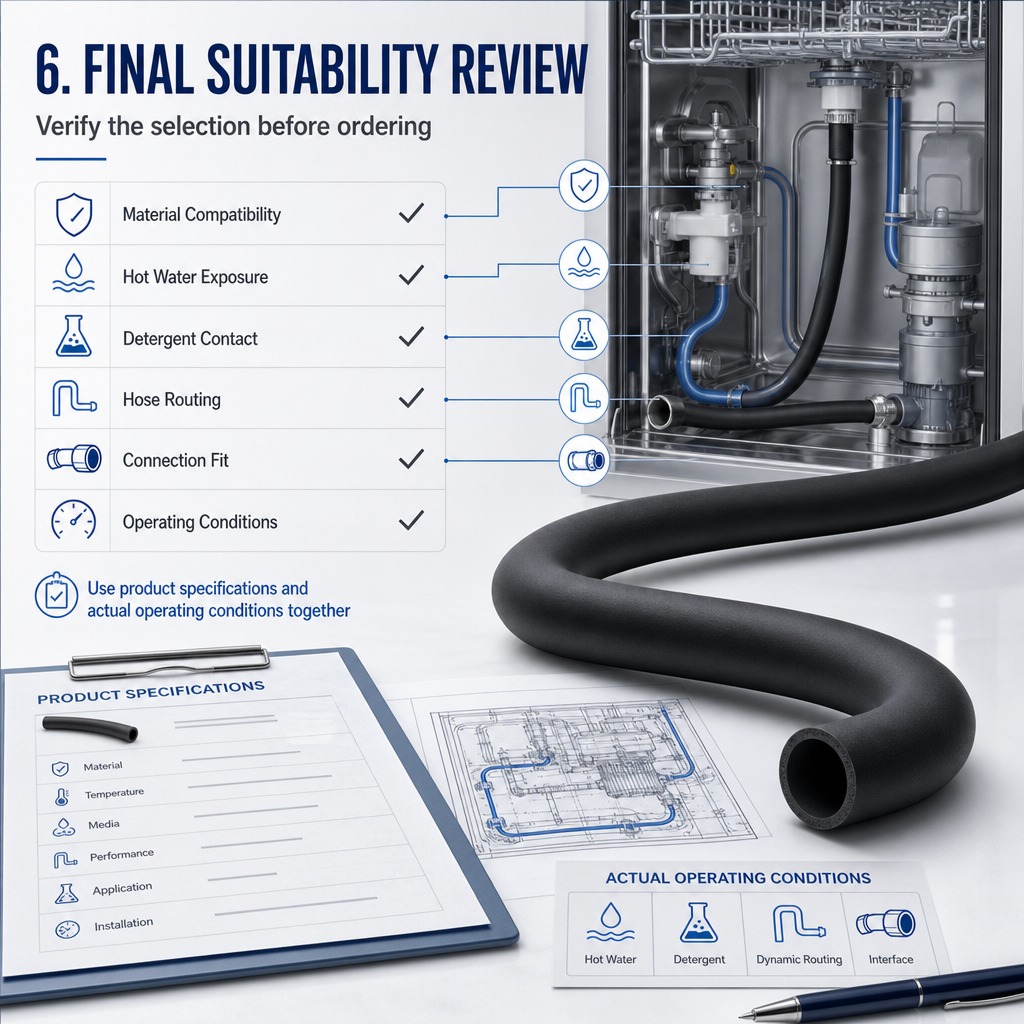
Application illustration: combine product specifications with actual operating conditions.
A practical manufacturing and approval workflow
Requirement review → compound and drawing agreement → sample manufacture → dimensional and visual inspection → application validation → production approval.
For extruded hose designs, agree the extrusion, curing and cutting requirements together with the dimensions to be checked. If the connection needs a formed shape or special end geometry, confirm the appropriate process separately. Inspection records and agreed acceptance limits connect the finished hose back to the approved specification.
Send a drawing or reference sample, ID/OD and length, mating-part details, routing information, fluid and detergent list, duty-cycle conditions, required approvals and order quantities.
Questions to resolve before ordering
Can any EPDM hose be used inside a dishwasher?
No. Suitability depends on the particular compound, hose construction, interface and operating conditions. Confirm it against the relevant product specification and application validation.
Does matching the inside diameter guarantee a sealed connection?
No. Review wall thickness, tolerances, connector geometry, retention method and the assembled joint under representative conditions.
Do material names or quality-system certificates establish water-contact compliance?
No. Request the documentation required for the specific product, intended use and target market. Do not infer food-contact or drinking-water approval from the EPDM name or a quality-management certificate.
Discuss your dishwasher hose specification with RESRUB
RESRUB / Dongguan Xingfeiyu Rubber And Plastic Products Co., Ltd. manufactures rubber hoses and extruded products. We support multi-variety, small-batch projects, free R&D design support and custom colors. MOQ starts at one piece; rapid tooling can be available in as little as two hours for eligible projects. Confirm applicability and delivery timing against your drawing and requirements.
Start with your application details and discuss a custom internal hose connection. Final suitability should always be verified against product specifications and actual operating conditions.