From Microplastics to Mold: How Silicone Tubing Specs Protect Coffee-Machine and Water-Filter Brands
- Share
- publisher
- RESRUB
- Issue Time
- Nov 10,2026
Summary
A practical guide for appliance-manufacturer engineers, quality, and sourcing teams: where food-grade silicone tubing sits inside coffee machines and water filters, how to specify and use it correctly, and how under-specifying the water path turns into recalls, litigation, and brand risk.
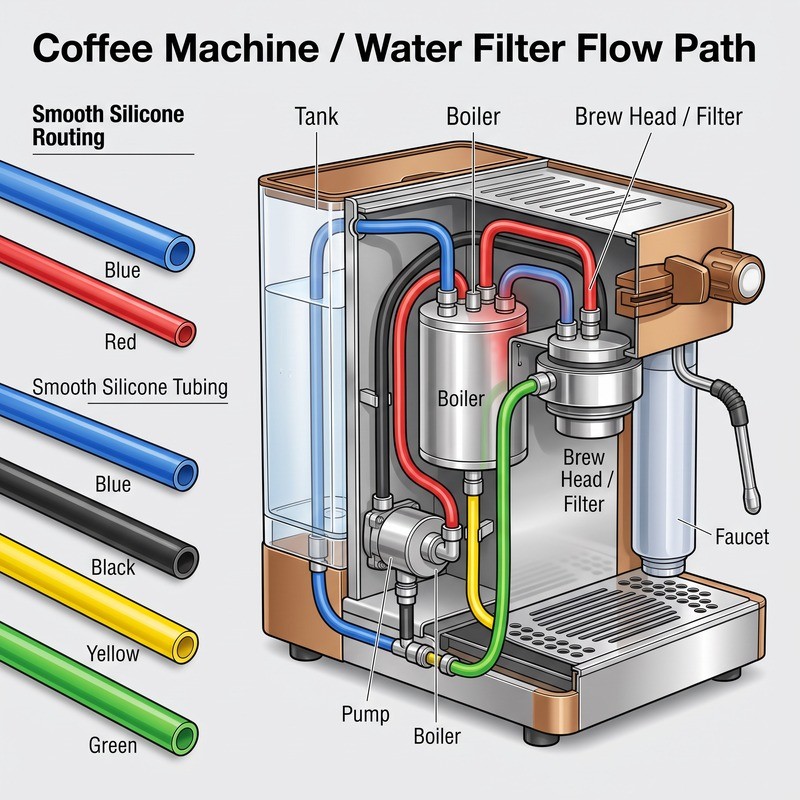
A practical guide for the engineers, quality leads, and sourcing teams who specify the water path: where silicone tubing actually sits inside coffee machines and water filters, how to use it correctly, and what happens when it is under-specified.
Coffee Machines Water Filters Food-Grade Silicone Correct Use & Spec
1. The Problem in Brief
For an appliance OEM, the most expensive component is rarely the one with the highest bill of materials. It is the one that fails in the field and pulls the brand into a recall, a class action, or a retailer's delisting list. Across coffee machines and point-of-use water filters, the failure — and the liability — consistently concentrates in the fluid path: tanks, pumps, boilers, and the tubing that connects them.
- A 2011 NSF International benchmark study found about half of home coffee makers harbored yeast and mold in their reservoirs and roughly 1 in 10 contained coliform bacteria; the reservoirs tested dirtier than toilet seats. A clinical-lab scientist later noted a simple hot-water rinse is only about 50% effective against common bacteria and molds.[1]
- In November 2024, a California Proposition 65 Notice of Violation named lead exposure from water-filter hoses (a filter shipped with a hose included) as the exposure route — i.e., the hose itself, not the media.[2]
- Countertop-appliance recalls measured in the millions of units are routine; the downstream cost of a single field failure scales with volume and legal exposure.[3]
The through-line: when the tubing in the water path is the wrong material, the wrong dimensions, or made with the wrong process, the symptom shows up as taste, odor, biofilm, leaching, or collapse — and because consumers cannot see inside the machine, the brand absorbs the blame.
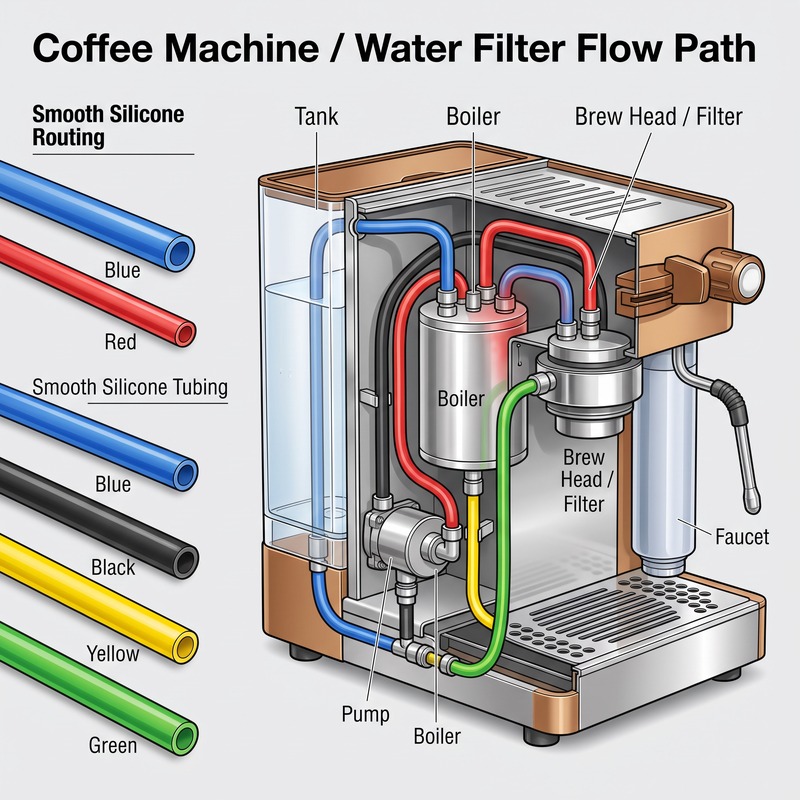
Cutaway of a coffee machine / water filter showing the internal fluid & steam path — the silicone tubing routing between tank, pump, boiler and brew head / filter and faucet is exactly the component this article is about.
2. Where Silicone Tubing Is Used: Application Scope
Before discussing specs, it helps to be precise about where silicone tubing does the work. In both appliance types it carries low-pressure hot water, steam, or filtered water between modules — never as a high-pressure line.
2.1 Coffee machine — fluid & steam path
From the water tank to the pump, then to the boiler, and on to the brew head and steam wand, silicone lines move hot water and steam around tight internal geometry where rigid parts cannot reach.
2.2 Water filter — inlet & outlet path
From the supply inlet to the filter housing, then to the faucet (and, for RO systems, the low-pressure permeate line to the tank), silicone provides clean, taste-neutral conveyance of drinking water.
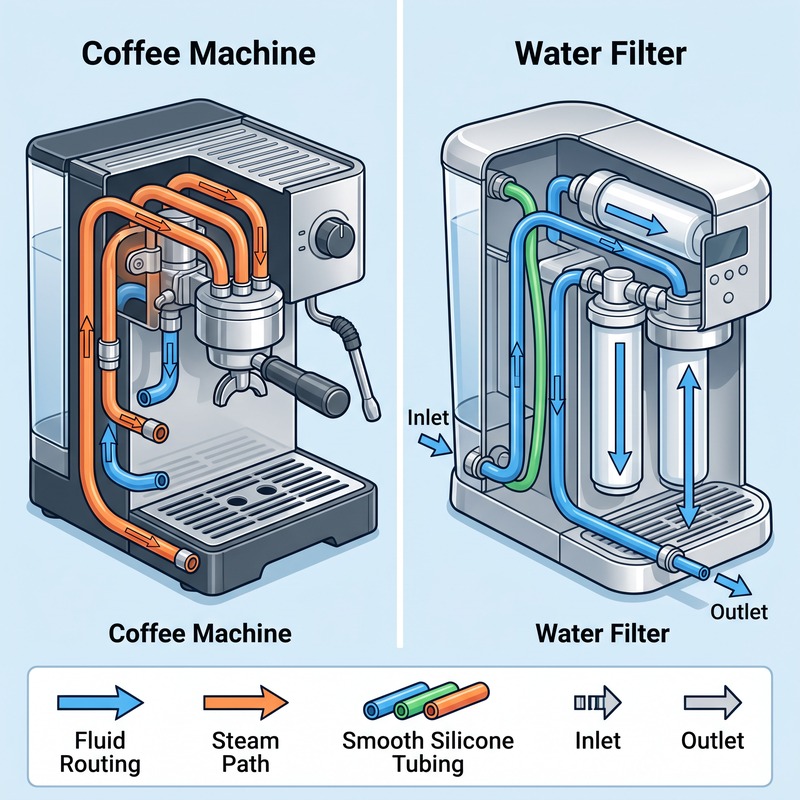
Where silicone tubing actually sits inside the two appliance types — coffee-machine brew/steam path and water-filter inlet/outlet path.
3. Correct Use of Silicone Tubing
Silicone is forgiving, but only within its design envelope. Most field problems trace to one of the following being ignored at spec or install time.
3.1 Choose the right material & cure
- Do specify platinum-cured food-grade silicone with post-cure for any taste- or drinking-water contact. It is neutral in taste and odor and leaves no peroxide by-products.
- Don't use peroxide-cured tubing on a taste-contact path: under-cured material can release residual siloxane oligomers and carry a faint odor or yellow tint, and is more likely to fail extractables testing.[5]
- Do require a cited food-contact compliance file — FDA 21 CFR 177.2600 (U.S.), and NSF/ANSI 51/61 if it contacts drinking water; EU Regulation 1935/2004 with LFGB/BfR where Germany is in scope. A "food grade" label with no test report on the actual compound and lot is not a compliance file.[5]
3.2 Dimensional & installation specs
- State ID, OD, wall thickness, and durometer on the drawing (typical food-grade tubing: 40–80 Shore A). Confirm concentricity so wall thickness is even around the bore.[5]
- Do respect the bend radius (generally ≥ 3–5× the tube OD for silicone) and use gentle, supported bends. Route away from sharp sheet-metal edges — add a grommet or sleeve where the tube passes a cutout.
- Do size the tube to the barb/push-fit precisely and secure with the correct clamp. A few tenths of a millimeter off spec is the most common cause of weep-at-joint warranty calls.
- Don't over-stretch or twist the tube during assembly, and don't kink it — both create thin spots and latent leaks.
3.3 Operating envelope
- Food-grade silicone spans roughly −40 °C to 200 °C (material-class figure), covering the brew and steam cycles of coffee machines and the ambient-to-warm duty of filters. Confirm the specific range against your thermal profile.
- Silicone stays elastic across thermal cycling, which is exactly why it resists the hardening/cracking that opens micro-leaks in lesser elastomers.
- It is intended for low-pressure fluid and steam transfer (tank/pump/boiler/brew-head and filter inlet/outlet lines). It is not a high-pressure hose — do not specify it for pressurized feed duties outside its rated envelope.
3.4 Chemical compatibility — what to keep away
- Resists well: water, steam, mild acids/bases, many food-grade detergents, and ozone/UV — which is why it is a sound choice inside beverage appliances.
- Avoid: petroleum-based oils, gasoline/diesel and other hydrocarbons, aromatic and chlorinated solvents, and concentrated strong acids/oxidizers. These swell, soften, or crack silicone and are the usual cause of premature failure when a line is routed near a non-compatible medium.
3.5 Cleaning & maintenance
- A smooth silicone bore is easy to flush and tolerates steam or CIP cleaning; this directly reduces the warm, damp conditions biofilm needs.[1]
- Do use manufacturer-approved descalers and confirm compatibility; don't use harsh oxidizers or solvent-based cleaners that attack silicone.
- Inspect periodically for hardening, stickiness, discoloration, or cracking, and replace on those indicators rather than on a fixed calendar alone.
3.6 Storage & shelf life
- Store coils in a cool, dry, dark place away from ozone sources (motors, welders) and direct sunlight. Keep ends capped and off the floor.
- Silicone ages slowly, but verify the lot's shelf-life and re-test extractables if a coil has been in storage beyond the stated window before it goes into production.
4. Why the Tubing Is the Linchpin: Failure-Mode Map
Condensed, the three independent variables that decide whether tubing does its job for ten years or becomes the weak link:
| Variable | What goes wrong if ignored |
|---|---|
| Material | Non-food-grade / unknown compound → plasticizer or heavy-metal migration (Culligan-type exposure[2]); wrong/under cure → odor, off-taste, leachables.[5] |
| Dimension | Out-of-tolerance ID/OD/wall → flow instability, pump pulsation, kinking or collapse under suction, weep at joints. |
| Process / docs | No cited food-contact certificate → compliance gap; no per-lot traceability → can't root-cause a field issue 18 months later. |
5. The Balance-Sheet Impact
Specifying the water path is traditionally owned by engineering, but the downside is borne by finance and legal. Three cost layers stack quickly: (1) direct recall & warranty logistics that scale with unit volume; (2) litigation and regulatory exposure — Prop 65 notices, state-AG actions, and class actions now read the fine print of what touches drinking water[2][4]; (3) brand and ESG erosion, where "clean" is the value proposition and a contamination story depresses conversion long after the PR cycle.
The counter-intuitive insight for a CFO: the cheapest place to spend is upstream — a better-specified tube and a documented compliance file cost cents per unit and retire the entire downside stack.
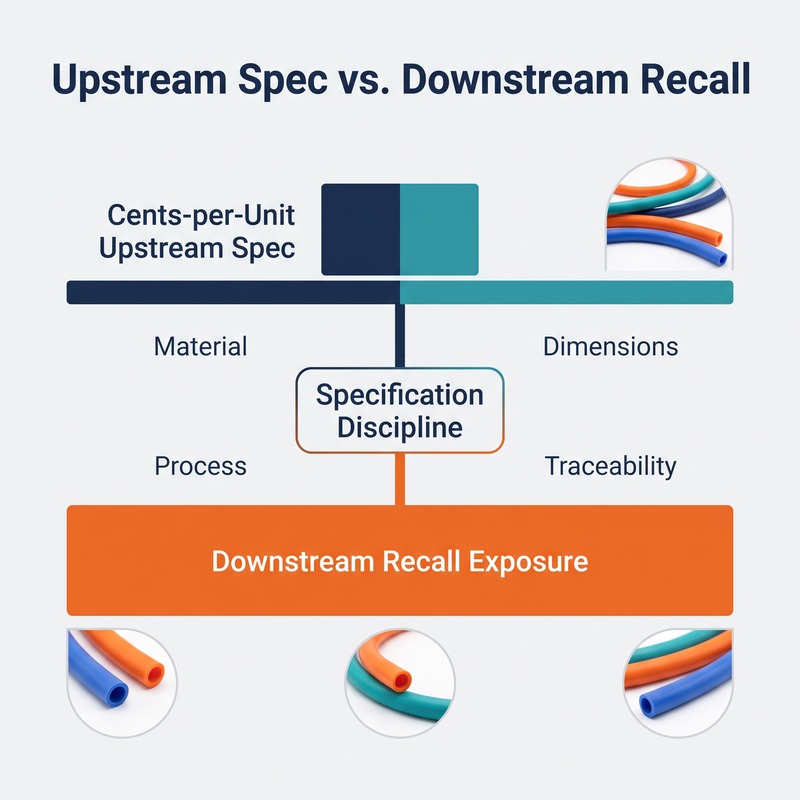
The counter-intuitive finance point: a better-specified tube and a documented compliance file cost cents per unit upstream, while a single field failure scales into recall and litigation exposure downstream.
6. Turning Hazards into Solved Problems: the RESRUB Approach
RESRUB (Dongguan Xingfeiyu Rubber And Plastic Products Co., Ltd.) supplies platinum-cured food-contact silicone tubing for exactly these fluid and steam paths — built on a certified quality system and a flexible manufacturing model that fits how appliance teams develop products.
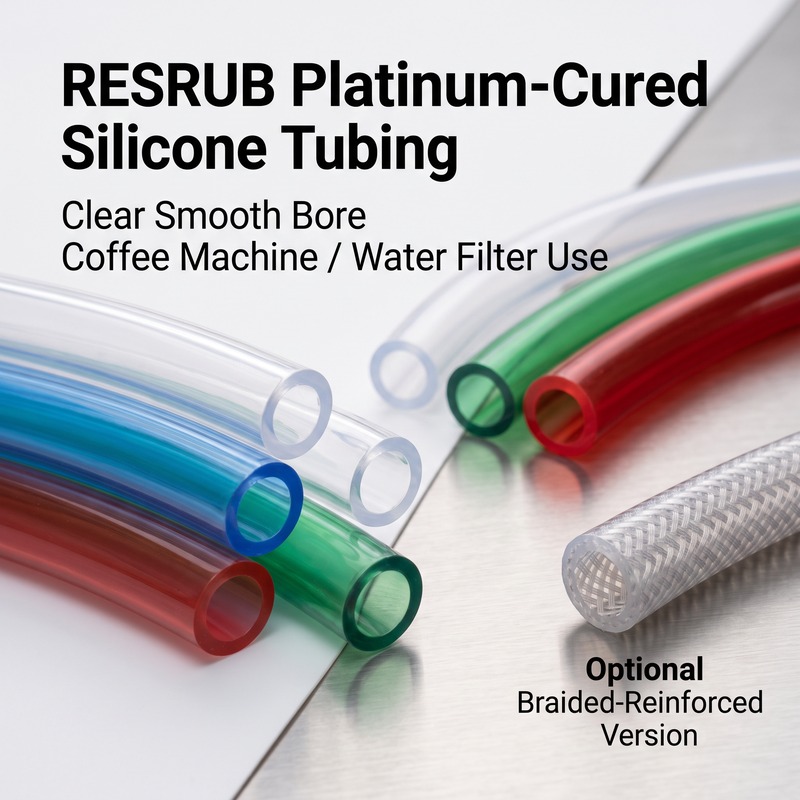
RESRUB platinum-cured food-contact silicone tubing — clarity, smooth bore, and the optional braided-reinforced version for dimensional stability under pump pulsation.
| Failure risk | How RESRUB addresses it |
|---|---|
| Material contamination | Platinum-cured silicone formulated for food contact; REACH & RoHS compliant; no plasticizer required by the chemistry; documented, traceable feedstock. |
| Odor / off-taste / leachables | Platinum cure + post-cure for neutral taste and odor; clean extractables profile for hot-water/steam duty. |
| Collapse / ballooning / kinking | Tight extrusion tolerances and consistent wall; optional braided (reinforced) silicone hose for dimensional stability under pump pulsation and brief suction — a structure RESRUB is proven in via its liquid-cooling braided-hose program and in-house braiding line. |
| Biofilm & cleaning difficulty | Smooth, flexible silicone bore that stays elastic across thermal cycles and is easy to flush / steam-CIP. |
| Compliance gap | Quality system certified to IATF 16949:2016, ISO 9001:2015, ISO 14001:2015; REACH/RoHS declarations; per-lot documentation. Food-contact certifications (e.g., FDA 21 CFR 177.2600, LFGB, NSF/ANSI 51/61) can be arranged for the specific compound and lot to support your market-entry file. |
| NPI & supply risk | MOQ 1 piece, 2-hour rapid tooling, free R&D design, custom sizes & colors, small-batch short lead time — de-risk prototyping and lock quality before volume. |
What this means for your program
You get a fluid-path component that is chemically clean for hot water and steam, dimensionally stable under pump dynamics, documented for the markets you sell into, and supplied on terms that let engineering actually test and iterate instead of compromising.
7. A Sourcing Spec Checklist for Appliance Teams
- Compound & cure: platinum-cured, post-cured; explicitly not peroxide-cured on any taste-contact path.
- Compliance target: name the standard (FDA 21 CFR 177.2600; NSF/ANSI 51/61 for drinking water; EC 1935/2004 + LFGB/BfR for EU) and ask for the current report on the actual compound and lot.[5]
- Dimensions: ID, OD, wall, concentricity, durometer (40–80 Shore A); confirm bend radius and fitting match.
- Temperature envelope: confirm −40 °C to 200 °C class range against your brew/steam cycle.
- Reinforcement: specify braided if the line sees pump pulsation or suction; confirm it still bends for your routing.
- Compatibility: keep away from oils, fuels, and solvents; confirm cleaner/descaler compatibility.
- Cleanability: smooth bore, steam/CIP tolerant, no odor.
- Documentation: per-lot CoA, REACH/RoHS declaration, certified quality system (IATF/ISO).
- Commercial terms: low MOQ and rapid tooling so you can validate before committing volume.
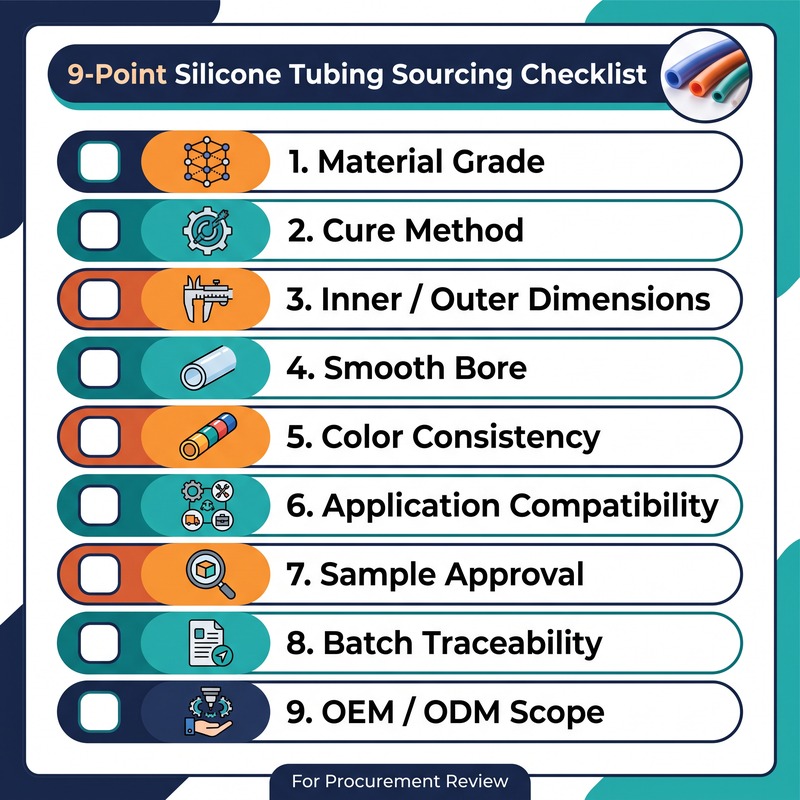
The 9-point sourcing checklist as a shareable infographic for your procurement and engineering teams.
8. Conclusion
The record is clear: in coffee machines and water filters, the failure and the liability concentrate in the fluid path. Taste, odor, biofilm, leaching, and collapse are not random — they are the predictable output of under-specified material, dimension, and process decisions. For brands competing on "clean" and "safe," treating the silicone tube as a documented, certified, correctly-used component — not a commodity — is what protects both the promise and the balance sheet.
Building or upgrading a coffee machine or water filter?
RESRUB supplies platinum-cured, food-contact silicone tubing — including braided-reinforced options — with IATF 16949 / ISO 9001 / ISO 14001 certified quality, MOQ 1, rapid tooling, and per-lot documentation. Contact our team to specify the right tube for your water path.
Related RESRUB resources
References
- NSF International benchmark study (2011) on coffee-maker reservoirs — ~50% yeast/mold, ~10% coliform; hot-water-rinse efficacy summary via Gentleman's Pursuits, Sept 2024. gentlemanspursuits.com
- California Office of the Attorney General — Proposition 65 Notice of Violation re lead in water-filter hoses (Culligan International Co. & The Home Depot), filed 1 Nov 2024. oag.ca.gov
- 电器杂志 (Dianqi Zazhi), "2025年中国产厨房电器产品在美国、加拿大和墨西哥召回情况" (compiled from U.S. CPSC / Health Canada recalls), 2 Feb 2026. dianqizazhi.com
- Brown v. The Brita Products Company, No. 24-6678 (9th Cir. 16 Apr 2026), affirming C.D. Cal. dismissal (30 Sept 2024) on filtration-performance claims. dailylaw.org/brita-filter-lawsuit
- Wetop Silicone, "Food Grade Silicone Tubing — OEM Sourcing Guide" (FDA 21 CFR 177.2600, LFGB §30/31, NSF/ANSI 51/61, platinum vs. peroxide cure, tolerances). wetopsilicone.com
- Yutian Silicone, "Why Braided Silicone Hoses Are the Preferred Choice for Coffee Machines in Europe" (EU compliance, heat/pressure stability, braided construction). yutiansilicone.com
- Home-Barista, "Plastics, Silicones, and Hazardous Materials in Espresso Machines" (siloxane-leaching discussion at espresso temperatures) — forum claims, attributed as such. home-barista.com
RESRUB is the overseas brand of Dongguan Xingfeiyu Rubber And Plastic Products Co., Ltd. RESRUB is not affiliated with, endorsed by, or sponsored by any brand named herein; brand names are cited solely as factual references to publicly reported recall, study, and litigation records. Food-contact certifications are arranged per project and compound; verify the current certificate and lot documentation before market entry. Temperature and performance ranges described for food-grade silicone are material-class figures, not RESRUB-specific tested values unless stated. Silicone tubing here is described for low-pressure fluid and steam transfer within beverage appliances, not as a high-pressure hose.